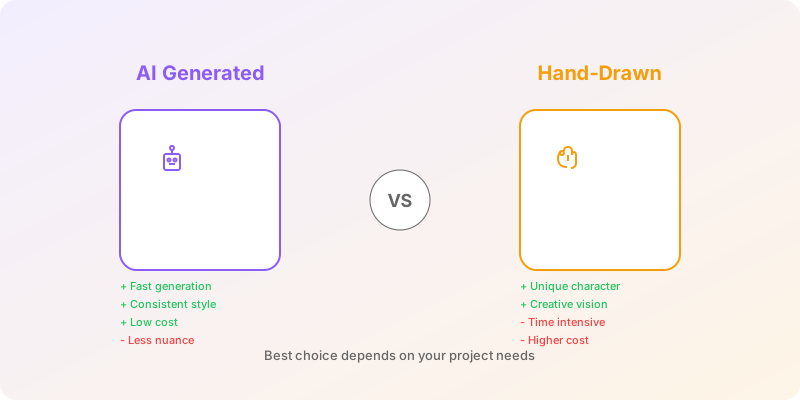
Key takeaways: AI-generated icons now match human-designed quality for most practical use cases, with casual users rarely noticing any difference after proper refinement. AI excels in speed (seconds vs hours), cost (up to 10,000x cheaper), and iteration flexibility. Human designers maintain advantages in set-wide consistency, pixel-perfect precision, metaphor accuracy, and strategic thinking. The best approach for most teams is a hybrid workflow: use AI for exploration and the long tail, commission humans for hero brand icons, and apply human judgment to review all output.
AI has transformed icon creation. What once took hours of skilled design work now takes seconds. But is the quality comparable? Can users - or even designers - tell the difference?
We examined this question by comparing AI-generated icons against human-designed sets across multiple dimensions. The results are nuanced and challenge assumptions on both sides.
The Test: AI vs Human Icons
We compared icons across five key criteria:
Consistency
Do icons in a set look unified?
Precision
Are stroke weights and geometry exact?
Recognition
Do users understand icons instantly?
Originality
Are icons distinctive and unique?
Where Human Designers Still Win
1. Set-Wide Consistency
When a design agency tackles a 100-icon set, they establish a system: grid, stroke weights, corner radii, optical corrections. Every icon follows identical rules.
A comparison study found that human-designed icon sets were accepted "without a single requested edit" because "stroke weights, corner radii and silhouette logic match perfectly."
AI can generate consistent icons, but it requires careful prompting and post-processing. Without these, each AI icon is essentially independent - no shared system governs them.
The gap is closing: Tools like Iconly address this with reference images and saved templates that enforce consistency across generations.
2. Pixel-Perfect Precision
Human designers work with vector tools that snap to exact coordinates. A 2px stroke is exactly 2px. A 4px corner radius is exactly 4px.
AI-generated icons may have subtle inconsistencies: a stroke that's 2.1px here and 1.9px there. For most uses, this is imperceptible. For brand-critical, enterprise design systems, it matters.
| Precision Factor | Human Designer | AI Generated |
|---|---|---|
| Exact stroke weights | Mathematically precise | Close, may vary slightly |
| Pixel-perfect alignment | Snapped to grid | Generally good, not guaranteed |
| Consistent corners | Defined in source file | Visual consistency, not measured |
| Optical corrections | Applied intentionally | Not reliably present |
3. Metaphor Accuracy
Icons represent concepts through visual metaphors. A good icon designer knows that a "router" icon should look like a router, not a generic box with antennas.
AI sometimes generates plausible-looking but inaccurate metaphors. It might give you an icon that looks like a nice piece of technology but doesn't actually resemble the specific device users expect.
4. Strategic Thinking
Human designers ask: "Is this the right icon for this concept? Will users understand it? How does it relate to other icons in the system?"
AI generates what you ask for. It won't tell you that your chosen metaphor is confusing or that your icon set has redundancies. The strategic layer requires human judgment.
Where AI Excels
1. Speed
There's no contest here. AI generates an icon in seconds. A human designer needs minutes to hours for a single icon, days to weeks for a complete set.
| Task | Human Designer | AI Generation |
|---|---|---|
| Single icon | 30-60 minutes | 3-10 seconds |
| 30-icon set | 1-2 weeks | 30-60 minutes |
| Iteration/revision | Hours to days | Seconds |
2. Cost
AI icon generation costs a fraction of human design. As our cost comparison details:
- AI: $0.01-0.10 per icon
- Professional designer: $100-200+ per icon
That's a 1,000-10,000x cost difference for comparable output quality in many use cases.
3. Iteration
Don't like the first result? Generate another in seconds. And another. And another. The ability to iterate rapidly means you can explore far more options than you could afford with a human designer.
With human designers, each revision round takes days and may cost extra. With AI, you iterate until you're satisfied at essentially zero marginal cost.
4. Accessibility
AI democratizes icon creation. Previously, custom icons required:
- Design skills (or hiring someone with them)
- Professional software licenses
- Time to learn icon-specific techniques
Now, anyone can describe what they need in plain language and get a usable result. This opens icon creation to developers, product managers, marketers, and small businesses that couldn't afford custom design. Developers can also generate and manage icons programmatically through the Iconly REST API. Try Iconly's icon generator to see how accessible the process has become.
The Real-World Test
Can users actually tell the difference? In most cases, no - if the AI icons are properly refined.
The key is that final step: refinement. Raw AI output often needs adjustment. With tools like Iconly's editor, you can:
- Unify stroke weights across icons
- Apply consistent smoothing and sharpening
- Center and crop uniformly
- Apply exact brand colors
After refinement, the practical difference shrinks considerably. For most applications - apps, websites, presentations, internal tools - refined AI icons are indistinguishable from human-designed ones to end users. Learn more about the refinement tools available in our features overview.
When to Use Each Approach
Use AI When
Speed matters, budgets are limited, or you need to iterate quickly on ideas
Use Human Designers When
Brand identity is critical, precision is paramount, or you need strategic guidance
AI Is the Right Choice For:
- MVPs and prototypes
- Internal tools and dashboards
- Content marketing and presentations
- Apps with moderate design needs
- Rapid experimentation and exploration
- Budget-conscious projects
- Supplementing an existing icon set
Human Designers Are the Right Choice For:
- Major brand identities
- Enterprise design systems used by multiple products
- Products where every pixel matters
- When you need strategic design consultation
- Highly specialized or technical iconography
- Long-term brand assets that will be used for years
The Hybrid Approach
Many teams are finding success combining both approaches:
- Use AI for exploration: Generate dozens of concepts quickly to find direction
- Commission humans for hero icons: Your logo and most important brand icons deserve human craft
- Use AI for the long tail: Secondary icons, variations, and expanding sets
- Apply human judgment: Review AI output for metaphor accuracy and brand fit
This gives you the speed and cost efficiency of AI with the quality assurance of human oversight. Beyond icons, the same workflow applies to ad creatives, email signatures, and brand assets.
The Verdict
Can you tell the difference between AI and human-designed icons? Sometimes. The differences are real but context-dependent:
| Context | Noticeable Difference? |
|---|---|
| Single icon in a UI | Rarely noticeable |
| 10-icon set with consistent post-processing | Minimal difference |
| 50+ icon system without refinement | Inconsistencies visible |
| Expert designer review | Subtle differences detected |
| Casual user perception | Rarely noticed |
For most practical purposes, the quality gap has narrowed enough that AI-generated icons are a viable choice. The question isn't "AI or human" but "what's the right tool for this specific job?" For a look at where both approaches are heading, read our 2026 icon trends roundup.
Try It Yourself
The best way to understand AI icon quality is to experience it. Sign up for Iconly and generate some icons. Compare them to commercial icon sets. Browse our public icon library or check out pricing plans to get started. See if you notice the difference.
You might be surprised by how good AI icons have become - and by how much time and money you can save while still getting professional results. Once you have icons, you can even turn them into ad creatives or generate vector assets from the same platform.
Frequently Asked Questions
Can you tell the difference between AI-generated and hand-drawn icons?
In most cases, users cannot tell the difference between AI-generated and hand-drawn icons when the AI output has been properly refined. For a single icon in a UI or a small set with consistent post-processing, differences are rarely noticeable to casual users. However, expert designers may detect subtle differences in stroke weight consistency and optical corrections, and large unrefined sets of 50 or more icons may show visible inconsistencies.
Where do AI-generated icons excel compared to hand-drawn?
AI-generated icons excel in four key areas: speed (generating an icon in 3-10 seconds vs 30-60 minutes for a human designer), cost (at $0.01-0.10 per icon vs $100-200 for professional design), iteration speed (unlimited variations at near-zero marginal cost), and accessibility (anyone can create custom icons by describing what they need in plain language without design skills or professional software).
Where do human-designed icons still win over AI?
Human designers still outperform AI in four areas: set-wide consistency where every icon follows identical grid, stroke, and corner rules; pixel-perfect precision with mathematically exact stroke weights and grid-snapped alignment; metaphor accuracy in choosing visual representations that users correctly associate with the intended concept; and strategic thinking about whether the right icon has been chosen for a concept and how it relates to other icons in the system.
When should I use AI icons vs hiring a designer?
Use AI icons for MVPs, prototypes, internal tools, content marketing, presentations, apps with moderate design needs, rapid experimentation, budget-conscious projects, and supplementing existing icon sets. Hire human designers for major brand identities, enterprise design systems used by multiple products, products where every pixel matters, when you need strategic design consultation, highly specialized technical iconography, and long-term brand assets that will be used for years.
What is the hybrid approach to AI and human icon design?
The hybrid approach combines AI and human design for the best results. Use AI for rapid exploration by generating dozens of concepts to find direction. Commission human designers for hero icons like logos and key brand icons that deserve handcrafted attention. Use AI for the long tail of secondary icons, variations, and set expansion. Then apply human judgment to review AI output for metaphor accuracy and brand fit. This approach gives you the speed and cost efficiency of AI with the quality assurance of human oversight.